Gun ownership per capita
The global firearm prevalence rate is 12 guns per 100 people (2022), with the United States having the highest civilian ownership rate at just over 120 guns per 100 residents, so 10x the global average.
The total global civilian stock is 857 million guns, with the US alone accounting for ~393 million, or 46% of the world total.
A deadly weapon
The main goal of the weapons is to be able to kill, so it’s not surprising that many die at the hand of a civilian gun, amoounting (in 2019) to an average of 2.7 firearm homicides per 100,000 people worldwide.
Death rates of gun violence vary dramatically by region, with Saint Kitts and Nevis (an island country located in the Caribbean) recording the highest gun homicide rate at 57 per 100,000 (2023), followed by Saint Vincent and the Grenadines (another island country in the eastern Caribbean) at 42 per 100,000 and Jamaica at 41. Conversely, countries like Singapore and Japan have some of the lowest violent death rates by firearm, ranging from 0.03 to 0.04 per 100,000.
Contrary to what many assume, while having the most guns per capita, the US is not the country with the most gun deaths per capita.
In 2023, the US had an age-adjusted gun death rate of 13 per 100,000, ranking it below several Latin American nations such as Venezuela (45), El Salvador (40), and Colombia (21)
Since 2020, gun violence accounts for over 8% of deaths in the US among those under age 20. It is the leading cause of death for that age group. Motor vehicle accidents are 2nd and Cancer is 3rd.
Globally, the United States has a higher rate of teen death by firearms than approximately 92% of all countries and territories.
Age-adjusted firearm homicide rates in the US are 77 times greater than in Germany, 33 times greater than in Australia and 19 times greater than in France.
These statistics underscore that the high level of gun violence in the US is not merely a result of overall crime rates, as the US does not have higher rates of nonlethal crime compared to these nations. It is generally accepted that this is specifically driven by the availability of firearms and weak gun laws that regulate sale restrictions, who can possess guns and where carrying guns is allowed. And, unfortunately, guns are accepted in some circles for settling disputes.
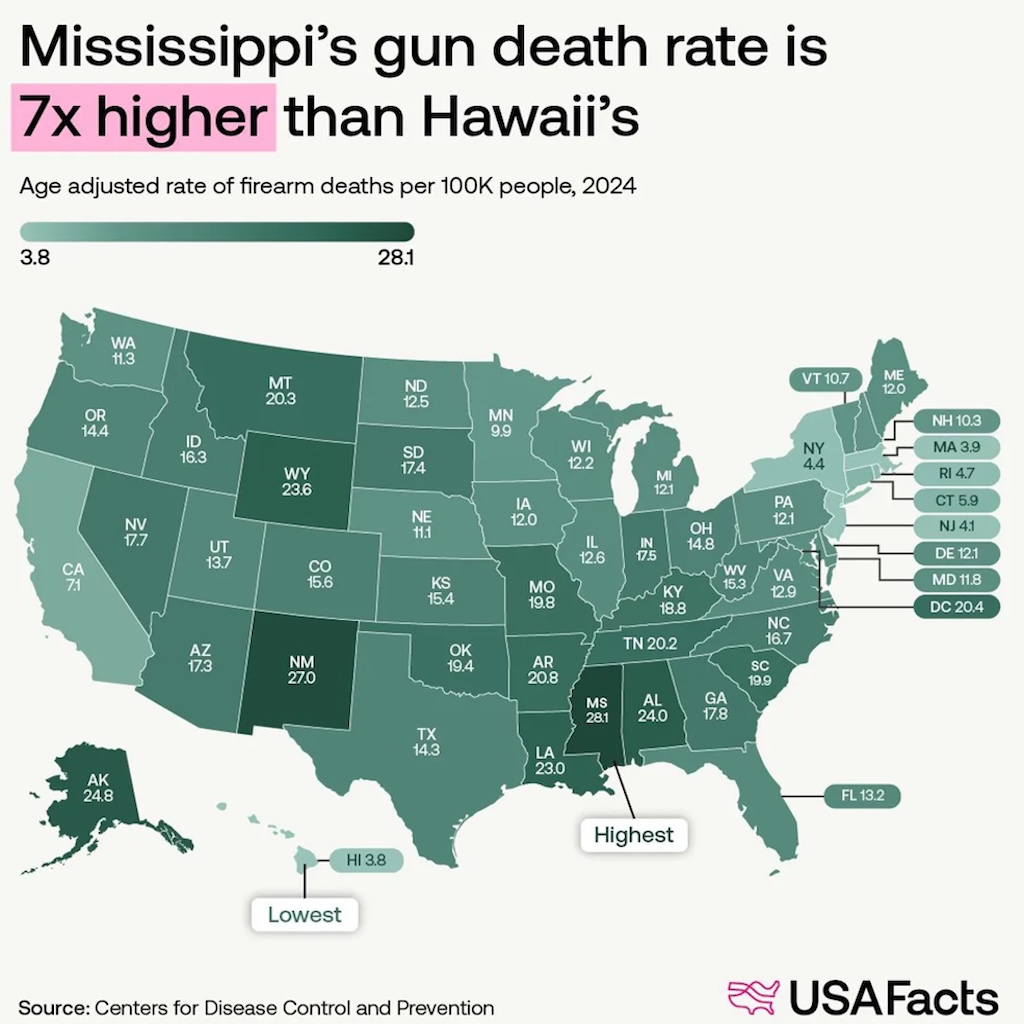
Firearm deaths in the US generally range between 40,000 and 50,000 a year, with suicides accounting for roughly 62% of all fatalities in 2024. Specifically, 44,447 people died from firearm-related injuries in the United States in 2024, according to the most recent comprehensive data from the Centers for Disease Control and Prevention (CDC) and Johns Hopkins’ Center for Gun Violence Solutions.
2nd amendment of the US constitution (anno 1791)
The US constitution’s Second Amendment is one single sentence: a well-regulated militia, being necessary to the security of a free state, the right of the people to keep and bear arms, shall not be infringed.
The reference to militia might be a surprise anno 2026, but is explained by the situation of the US when the constitution was adopted, especially in the crucial state of Virginia. There were many more slaves than slave owners. The slave owners were scared that the slaves would revolt out of control. So the Virginia delegation insisted that a state controlled law enforcement force (a militia) was needed to control the slaves. And that militia needed to be armed. Slaves, obviously, would not be allowed to have guns, as African Americans were explicitly excluded from the category of the people at the time the US constitution was ratifified in 1791.
As a result of this 2nd amendment, in 2025 about a third of US adults say they personally own one or more guns. At the same time the US Surgeon General in 2024 has taken the unprecedented step of declaring gun violence a public health crisis.
Attempts to limiting gun ownership
A significant portion of those who like to see a lower number of deaths by guns is traditionally aimed at limiting gun ownership.
This has not been very successful. The US Supreme Court is interpreting the 2nd amendment in the broadest sense possible, and has supported most, if not all, of the demands of the gun lobby. This includei a ruling that none of the 50 states can impose laws and regulations that are in conflict with federal laws.
Around 26 million Americans can be counted as first-time gun owners between 2020 and 2024. This historically unusually high influx expanded the total estimated number of civilian-owned firearms to 500 million, or roughly 1.5 guns per person.
Nearly half of these new owners are women, with African American women identified as the fastest-growing demographic of new buyers.
The 2025 data indicates that there is a small downturn in the number of households with one or more guns which now stands around 40%
Gallup has tracked metrics of gun ownership annually since 2007, showing a peak in the Covid years, but no clear increase or decrease in gun ownership over that entire time.
Gun dealers in the US are prohibited from selling handguns to those under the age of 21, and long guns to those under the age of 18.
Lack of research
In the United States, research into firearms and violent crime is fraught with difficulties, associated with limited data on gun ownership and use, firearms markets, and aggregation of crime data. Proponents of widespread gun ownership often manage to limit the available funds for gun related research.
In 1996 the so called Dickey Amendment prohibits federal funds from being used to advocate or promote gun control. Though it doesn’t literally ban research, the Centre for Decease Control, CDC, interpreted it so broadly that it eliminated all federal funding for firearm injury research. No regular state-level data series on gun ownership or use has been collected since the CDC dropped it from its Behavioral Risk Factor Surveillance System more than two decades ago. In 2017 a JAMA (Journal of the American Medical Association) analysis found that gun violence is the least-researched among leading causes of death.
The net result: researchers can piece together a partial picture from multiple imperfect sources, but the US lacks the kind of comprehensive, longitudinal, well-funded data infrastructure that should be, and mostly is, standard for any other problem killing ~45,000 people per year.
Not so common approaches to reduce gun deaths
The most common approach of politicians is to legislate the ownership of guns, which aims to for example ban so called assault rifles, event though hand guns are responsible for almost all deaths. Often bitter disagreements and polarization has resulted in a patch work of different levels of control at state level about who can own and carry what type of gun.
There are some other approaches worth considering.
Improve health care
The success rate of preventing the death of victims who are shot, has been increasing. So, perhaps ironically, while the number of guns being fired is going up, the number of deaths has not increased proportionally. Advances in medical care and Emergency Response (especially in the cities) are keeping more victims alive than ever. It should be noted that the US has no system that comprehensively measures all nonfatal firearm injuries.
Nevertheless an interesting claim is that if we held the level of healthcare constant from 1960 onwards, we’d have 75,000 gun homicides a year in this country.
EMTs, doctors and nurses save lives.
Improve prevention of firearm suicides
Because firearms are highly lethal and suicide attempts are often impulsive, strategies prioritize creating physical and temporal barriers between individuals in crisis and firearms. This results in red flag laws that allow a temporary ban on possession of fire arms for a person deemed at risk for the misuse of firearms.
Also pursued are stricter laws about where guns are stored, to make them less easily accessible, and thirdly:
Mandatory waiting periods between firearm purchase and possession to create a cooling off buffer against impulsive acts.
Better handling of dispute resolution
While a majority explains their gun purchase as being for protection and self-defense, in reality that is not the reason guns are being fired.
There are 2 categories in which a homicide falls. One is instrumental violence, that is to say, I shoot you and kill you in the cause of some other goal, the other is Expressive violence
Instrumental violence
- You’re wearing a Rolex, I want your Rolex. You struggle. Okay, I shoot you. I take your Rolex.
- I’m robbing a bank, I shoot the non cooperating bank clerk and take the money.
- I’m defending my turf against some rival gang to sustain my drug trafficking.
Expressive violence This is the violence that comes out of raw emotion.
- It comes out of a sense of injury, of personal antagonism, mental illness, out of revenge.
- It’s impulsive.
- If I thought twice about it, I wouldn’t do it.
While legally the assumption is that gun laws protect law enforcement, hunters, property defenders and other instrumental violence, in the real world almost all death are the result of expressive violence.
Often a locality with a relative high number of (youth) gun death, displays a pattern of endless cycles of retaliation and revenge. Kids are taught that shooting someone is a legitimate way to handle a dispute.
Billy’s friend just got shot. In the current climate Billy is at risk of shooting a suspected perpetrator in revenge. And then they’re going to come after his family: the circle is in motion.
How about somebody should go and see Billy. Does anyone know Billy’s dad? Can we move the relevant families to a hotel for 2 weeks till things calm down, so they don’t get caught in a crossfire? Send the pastor to his house? The pastor knows that family for years.
An effective response not just from the police but from community leaders.
Likely, Billy is desperate and would want to escape the violence. So tell him, we’ll get him housing and some grief counseling because he’s lost so many friends over the last years. Also, tell and show him that he does not need to provide the revenge. An adequate response from law enforcement and social work should provide some comfort and show him that he can have confident this is handled, rather than acting upon the advice from those that tell him he should take matters in his own hands.
The city of Baltimore has an interesting project going along these lines and has seen a significant reduction in gun deaths.
Yes, the US constitution has made it complicated
So, Western Europe and the United States as a share of GDP, spend roughly the same amount of money on public safety. In Europe, they spend most of that money on police and a little bit on prisons. The US spend most of it on prisons and a little bit on police. Berlin and Los Angeles are somewhat equivalent in terms of number of people. Berlin has a 18,000 police force, LA has 8,500 cops or 47% of what Berlin has.
This disparity means that a resident of Los Angeles faces a much higher risk of gun-related violence than a resident of Berlin. Comparisons suggest that the likelihood of being murdered with a gun in Germany in one year is equivalent to living in the United States for only 5 to 10 days, depending on the specific state or city comparison. While Los Angeles has seen reductions in gun homicides recently (e.g., a 26% drop from 2023 to 2024 in some reports), the absolute numbers and rates remain vastly higher than those in Berlin, where gun violence is rare and often involves specific criminal disputes rather than widespread community violence.
The efforts to clarify, refine, perhaps restrict what the US constitution supports in terms of gun ownership and thus what it means for related gun deaths will last another 50 and more years and the likelihood the outcome will restricts availability is lower than it expanding gun ownership further.
In the meantime it seems worthwhile to put more emphasize on the norms, moral, ethics and practices that should go hand in hand with freely available guns. Reducing expressive violence is the target here.
A little less than 1,500 cyclists are killed each year on the roads in the US: Nobody is arguing to ban bicycles or cars. It is a worthwhile goal to get to below 1500 gun deaths a year and remove a polarizing element from the public discourse at the same time.