While I was helping a local farm selling produce at a farmers’ market, I noticed a nearby stand promoting awareness of meth and fentanyl addiction and advocating that more efforts are needed to combat deaths and provide treatment for this addiction.
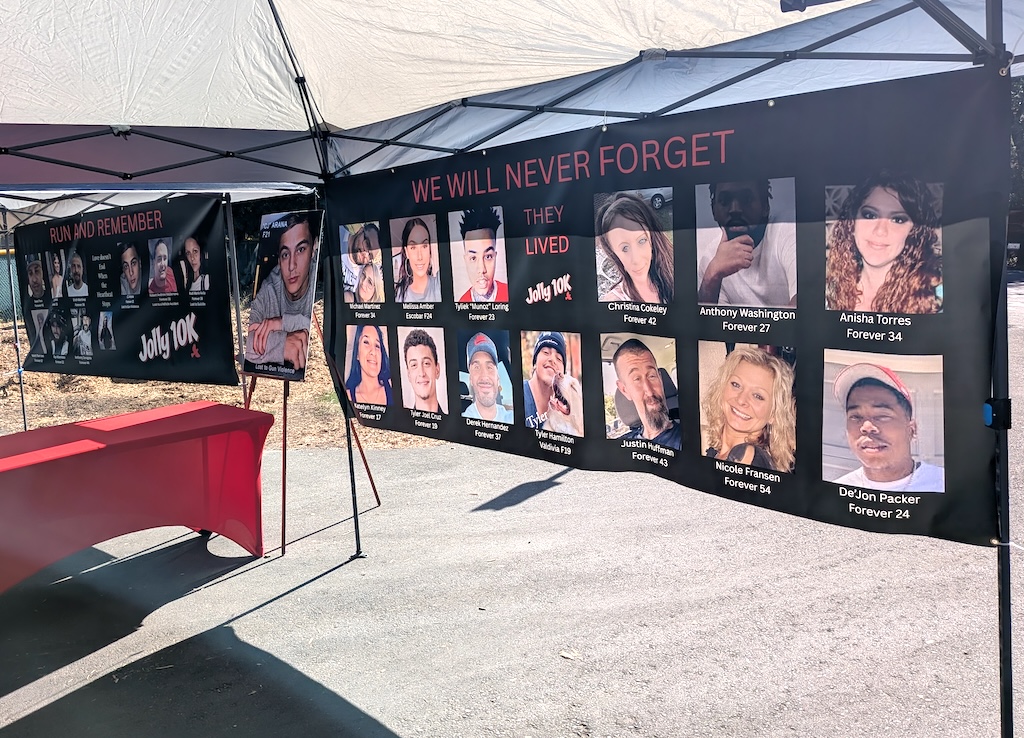
Leslie lost her son to a fentanyl overdose a few years ago. Since then she tries to raise awareness for treatment and care for those addicted. In addition to organizing stands at things like this farmers’ market, she introduced me to a yearly gathering, centered around a 10K walk/run.
And so, for the last few years I’ve participated in this yearly 10K run and the gathering of participants afterwards. The finish area has information stands, food, a raffle and even a keynote speaker. Narcan (to be given immediately after an overdoses) is freely distributed. Leslie wants to make sure nobody leaves the event without it. There’s also CPR training provided by the county’s fire department.
This year I joined up with two parents who lost their daughter to an overdose. They can’t run for 10k, so we settled for a walking pace most of the way, starting early in the day to avoid the heat. They told me about the mental support this kind of gathering provides.
Fentanyl remains the leading driver of overdose mortality and the dominant cause of death for Americans aged 18 to 44.
Losing a daughter
Their daughter struggled her whole life with substance abuse. It sounds like she had a lot of unresolved trauma that she never had something like proper therapy for. Instead, medicating herself was her a way through that. She had an illness that she ultimately succumber to.
What started as an experiment turned into cool parties and within a few years transformed her life into a nightmare. On again, off again periods of substance abuse, some lasting a year or more, came and went
Her death came as a shock.
Her parents didn’t know she was using again. On the contrary, she seemed to be doing well at the time. And that makes her a kind of conundrum. She was such an amazing artist, it is hard to combine that notion with what eventually ended her life.
When you lose someone to addiction like that, you wonder how the drug is so powerful that it can take people from you. The soul and vibrancy is taken away and all you can see is the gray shell of a former personality, who is seriously sick.
Indeed, she told her parents that initially she was curious about that perceived power of meth and fentanyl. Where does it get the force from to be more powerful than the bonds between people, so much so that it can break those bonds apart.
Heck, it often is even stronger than the bond between a parent and their child or vice versa. For some, that kind of power is irresistible and makes trying to tap into that power a must.
Nationwide decline
The modern US opioid crisis began in the 1990s, with the rising abuse of prescription opiates such as OxyCotin. A crackdown on legal opiates in the 2010s led to increased use of illegally sourced opiates, especially fentanyl. Deaths from overdose rose sharply, peaking in 2022 at a rate of 33 deaths per 100,000 people.
Based on provisional CDC data for the 12-month period ending in April 2025, the United States experienced a significant decline in overdose mortality, with the national rate falling to approximately 23.3 per 100,000 (derived from 76,516 total deaths).
Indeed, fentanyl-related overdose deaths in the USA are declining, marking the first sustained drop in almost 10 years. After peaking at over 108,000 total overdose deaths in 2022 national, mortality fell to under 100,000 in 2024, with fentanyl-involved deaths dropping sharply by 35.6% from 2023 to 2024. This trend has continued into 2025, representing tens of thousands of lives saved, though fentanyl remains the leading driver of overdose mortality and the dominant cause of death for Americans aged 18 to 44.
It appears, synthetic opioids (primarily fentanyl) accounted for approximately 69% of all overdose deaths, with an estimated 48,000 to 60,000 fatalities in the 2024–2025 period.
Regional hot spots
The fentanyl and meth addiction crisis is highly uneven across the USA, with distinct regional hot spots. While the national trend is downward, specific states, particularly in the Southwest and Appalachia, continue to face severe or worsening epidemics.
The following states reported the highest all-drug overdose death rates in 2025, with fentanyl involved in the vast majority of these fatalities:
| State | Per 100,000 | Deaths |
|---|---|---|
| Alaska | 49 | 364 |
| West Virginia | 35 | 627 |
| Pennsylvania | 34.2 | 4,456 |
| Ohio | 33.9 | 3,998 |
| Kentucky | 33 | 1,498 |
| Tennessee | 32 | 2,287 |
The following states reported the lowest all-drug overdose death rates in 2025:
| State | Per 100,000 | Deaths |
|---|---|---|
| Idaho | 6 | 124 |
| Nebraska | 12 | 239 |
| Texas | 12.7 | 4,980 |
| New Jersey | 12.7 | 1,992 |
90% of states (45 states plus DC) saw a decline in overdose deaths compared to the previous year, with California reducing its rate by 25.8% to 26.0 per 100,000.
American Indian and Alaska Native populations experienced the highest rates, ranging from 56.6 to 65.2 per 100,000, significantly above the national average.
Los Angeles County alone saw a historic 37% drop in fentanyl deaths in 2024, attributed to massive investments in harm reduction and treatment.
Multiple factors appear to be driving this decline.
Research points to a supply-side shock, with substantial lower imports of the pre-cursor chemicals from China into Mexico and Canada. This led to reduced fentanyl potency and availability. Combine that with expanded harm reduction efforts such as wider naloxone (Narcan) distribution and increased access to medication-assisted treatments like methadone and buprenorphine.
Additionally, there is evidence of decreased demand, particularly among Generation Z, where overdose risk for those aged 20 to 29 dropped by 47%, potentially due to heightened public awareness of overdose risks.
Researchers point out that if China has been able to significantly reduce the amount and quality of pre-cursor chemicals being exported, thus helping to reduce overdose deaths in US and Canada, they could equally well turn the spigot back on, should that suit their position.
Arizona, New Mexico and Colorado
Contrary to the national decline, the Southwest has seen overdose deaths rise sharply. Arizona is the most notable outlier, with overdose deaths increasing by 17% in 2025 while the rest of the country dropped by 14%. Fentanyl-related deaths in Arizona specifically jumped by 33%.
Officials cite Arizona’s location as a primary trafficking corridor, an increasingly volatile drug supply (fentanyl mixed with meth), and a shift toward fentanyl powder.
New Mexico and Colorado also reported increases of over 10%, bucking the national trend.
In the US, even with the recent declines in both car accidents and other traffic deaths and substance abuse deaths, drug overdoses are expected to remain roughly twice as deadly annually as traffic accidents.
The crisis is not resolved
Despite the progress, the crisis cannot be marked as resolved. In 2025, an estimated 15% of Americans aged 12 or older live with a substance use disorder, which corresponds to approximately 44.6 million people. 25.7M with alcohol use disorder, 26M with a drug use disorder and 7.1M with both alcohol and drug use disorders. Of the 44.6M, one in five had a severe disorder.
The overall numbers represents a decline from the 2024 prevalence rate of 16.8%
The treatment gap remains enormous with for example fewer than 8% of those with alcohol use disorder receiving care.
The recovery is also geographically uneven; while states like Virginia and North Carolina saw significant decreases, Arizona, Alaska and Oregon have reported rising overdose rates, highlighting the need for continued targeted public health interventions.
Methamphetamine remains a primary driver of death, often in combination with fentanyl. While fentanyl dominates the headlines, states like Arizona, California, and Hawaii have historically high rates of meth use.
In many of these regions, a polysubstance trend (using meth and fentanyl together) is fueling the continued high mortality rates even as pure opioid deaths fall elsewhere.
The National Safety Council computes that recent 2025 US data indicates the odds of dying from an accidental opioid overdose are approximately 1 in 84, while the odds of dying in a motor vehicle crash have improved slightly to 1 in 101.